
Switching to an on-demand water heating system is one of the smartest investments a homeowner can make, offering continuous hot water and superior energy efficiency. However, in Bexar County, the exceptional mineral content of our municipal supply presents a unique challenge for residential plumbing systems. According to water quality data from the San Antonio Water System (SAWS), local groundwater hardness frequently measures between 15 and 20 grains per gallon, categorizing it as very hard water [1]. When untreated mineral-rich water flows through the compact heat exchanger of a modern tankless unit, intense thermal energy causes calcium and magnesium ions to precipitate out rapidly, forming stubborn scale deposits [2]. Without proactive tankless water heater maintenance san antonio residents risk premature component failure, reduced energy efficiency, and restricted water flow.
At Bluebonnet Plumbing, our licensed plumbing professionals provide expert tankless vs. traditional water heaters guidance, annual descaling, and comprehensive system care during regular business hours. Understanding how scale accumulates and knowing when to schedule professional service ensures your high-efficiency appliance operates reliably for its full expected lifespan.
The Chemistry of Hard Water and Tankless Heat Exchangers
Traditional storage tank water heaters accumulate sediment primarily at the bottom of the tank, which can be mitigated with periodic flushing [3]. In contrast, tankless water heaters pass water over high-efficiency metallic heat exchanger coils heated by powerful gas burners or electric elements. Because these heat exchangers operate at significantly higher temperatures than traditional tanks, dissolved calcium carbonate and magnesium carbonate instantly separate from the water and adhere to the interior metal surfaces [2].
Over time, even a microscopic layer of scale acts as an insulating barrier between the burner and the water. This thermal barrier forces the unit to work harder and fire longer to reach your desired tap temperature, driving up utility bills and triggering error codes. Furthermore, severe scale accumulation restricts internal water flow rates, causing fluctuating water temperatures and unnecessary strain on internal flow sensors and water control valves.
Why Annual Descaling Is Non-Negotiable in Bexar County
Major manufacturers such as Rinnai and Navien explicitly state in their owner manuals that annual flushing and descaling are mandatory requirements to maintain warranty coverage [2] [3]. In regions with severe water hardness like San Antonio, waiting two or three years between services allows hard scale to calcify solidly inside the narrow micro-channels of the heat exchanger.
To combat hard water effectively at the source, many local homeowners pair their tankless units with a whole-house San Antonio water softener solutions installation, which removes calcium and magnesium ions before they ever reach the appliance. However, even with a water softener installed, professional annual checkups remain essential to verify system integrity, inspect venting connections, and clean internal inline water filters.
| Maintenance Task | Recommended Frequency | Primary Benefit | Service Type |
|---|---|---|---|
| System Descaling & Flush | Annually (Every 12 Months) | Removes calcium scale, preserves heat transfer efficiency | Professional Licensed Plumber |
| Inlet Water Filter Cleaning | Every 6 Months | Prevents particulate debris from entering flow sensors | Homeowner / Professional |
| Venting & Gas Line Inspection | Annually | Ensures safe combustion exhaust and prevents gas leaks | Professional Licensed Plumber |
| External Visual & Leak Check | Monthly | Detects early moisture, condensation, or minor drips | Homeowner Visual Check |
The Professional Tankless Descaling and Flushing Process
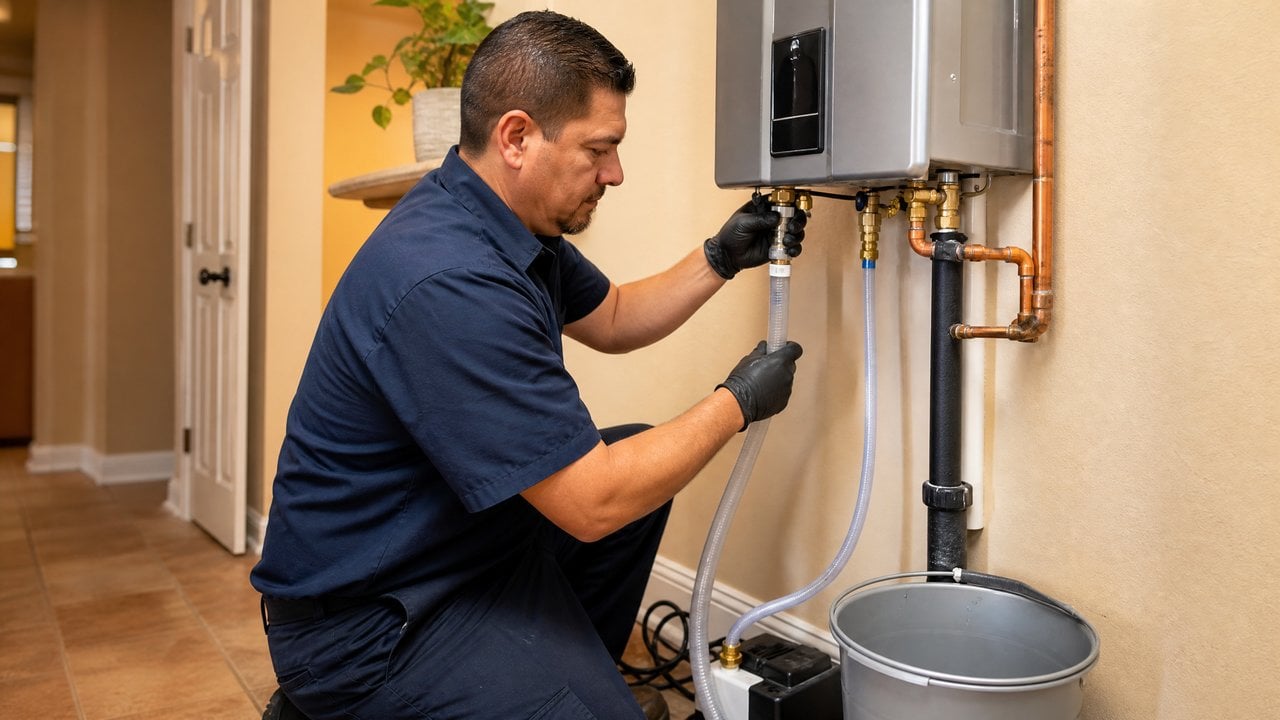
While DIY descaling kits are marketed online, executing a proper tankless flush involves handling chemical descaling agents, disconnecting pressurized water lines, and working safely around gas or high-voltage electrical connections. Professional San Antonio tankless water heater service follows a rigorous multi-step procedure to ensure thorough cleaning without damaging delicate internal components:
- Power and Gas Isolation: The technician safely shuts off electrical power and gas supply to the unit to prevent accidental ignition or thermal shock.
- Isolation Valve Operation: Closing the hot and cold water isolation valves isolates the heat exchanger from the main plumbing system.
- Hose and Pump Connection: Connecting a specialized commercial descaling pump and food-grade hoses to the hot and service ports.
- Circulating Descaling Solution: Circulating an undiluted food-grade white vinegar solution through the heat exchanger for 45 to 60 minutes to dissolve mineral scale [2].
- Flushing and Neutralizing: Flushing the system thoroughly with clean potable water before opening isolation valves and restoring power and gas.

Inlet Filter Maintenance and Routine Homeowner Checks
In addition to annual descaling, tankless water heaters feature a cold water inlet filter screen designed to catch particulate debris, pipe scale, and sand before water enters the flow sensor. Over months of operation, sediment can collect on this screen, leading to reduced water pressure and flow errors.
Homeowners can gently inspect and rinse this cold water filter screen periodically, provided the system is completely depressurized and cool. For detailed guidance on maintaining overall plumbing health, consult our comprehensive water heater flush maintenance guide. If you notice persistent pressure drops or unusual error codes flashing on your unit’s digital display, it is time to schedule expert assistance.
Schedule Professional Tankless Maintenance Today
Protect your investment and enjoy uninterrupted hot water year-round. Bluebonnet Plumbing provides expert tankless water heater maintenance, descaling, and repair services during regular business hours.
Call us today at (210) 934-5468 or reach out online to book your service appointment.
Frequently Asked Questions About Tankless Maintenance
How often does a tankless water heater need to be flushed in San Antonio?
Due to San Antonio’s high mineral content (15–20 grains per gallon), tankless water heaters must be descaled and flushed at least once every 12 months [1] [2]. Homes without a water softener may require more frequent servicing.
Can I use harsh chemical descalers instead of white vinegar?
No. Major manufacturers such as Rinnai explicitly require the use of undiluted food-grade white vinegar and strictly prohibit harsh chemical solvents, which can corrode stainless steel heat exchangers and void your manufacturer’s warranty [2].
What are the common signs that my tankless water heater needs descaling?
Common warning signs include fluctuating water temperatures, longer wait times for hot water at the tap, reduced water flow rates, or digital error codes (such as ignition or scale errors) appearing on the unit’s control panel.
Why is professional servicing recommended over DIY descaling?
Tankless water heaters involve active gas lines, electrical circuits, and pressurized water connections. Professional plumbers ensure proper valve manipulation, safe chemical disposal, and comprehensive safety checks for venting and combustion efficiency.
References
- San Antonio Water System (SAWS). “Water Quality and Hardness Standards.” https://www.saws.org
- Rinnai America Corporation. “Tankless Water Heater Maintenance and Flushing Guidelines.” https://www.rinnai.us
- Navien Inc. “Tankless Water Heater Descaling and Maintenance Procedures.” https://www.navieninc.com
- U.S. Department of Energy. “Energy Saver: Tankless Water Heaters.” https://www.energy.gov
Ready for Expert Plumbing Service in San Antonio?
Trust Bluebonnet Plumbing for transparent, professional plumbing maintenance and repairs during business hours.