
If your morning shower has been running lukewarm — or your water heater is making strange popping sounds from the garage — it might be time to start thinking about a water heater replacement in San Antonio. And if you're going to replace it, you might as well make sure you're choosing the best option for your home, your family's hot water needs, and the unique demands of living in South Texas.
The two most popular choices for San Antonio homeowners today are traditional tank water heaters and tankless (on-demand) water heaters. Each comes with its own set of advantages, drawbacks, and important considerations — especially when you factor in San Antonio's notoriously hard water, our hot summers, and the age of many homes across neighborhoods like Alamo Heights, Stone Oak, Helotes, and the near-West Side.
In this guide, the team at Bluebonnet Plumbing breaks down everything you need to know so you can make a confident, informed decision about your next water heater.
How Do Traditional Tank Water Heaters Work?
A traditional storage tank water heater is the type most San Antonio homeowners are familiar with. It's the large cylindrical unit — usually 40 to 50 gallons for a single-family home — that sits in your garage, utility closet, or attic. Here's the basic process:
- Cold water enters the tank through a supply line.
- A gas burner or electric heating element heats the water inside the tank to a preset temperature (typically 120°F–140°F).
- The heated water is stored in the insulated tank until you turn on a hot water faucet.
- As hot water leaves the tank, fresh cold water flows in to be heated — and the cycle continues.
Pros of Traditional Tank Water Heaters
- Lower upfront cost: Tank water heaters are generally less expensive to purchase and install, making them a budget-friendly choice for many families.
- Simple installation: Because most San Antonio homes are already set up for a tank unit, replacing one is usually straightforward — no major retrofitting required.
- Reliable hot water reserve: A full tank means you have a ready supply of hot water on hand for back-to-back showers, laundry, and dishes.
- Easier maintenance: Tank water heaters have fewer complex components, and most licensed plumbers are highly experienced with their upkeep.
Cons of Traditional Tank Water Heaters
- Standby energy loss: The tank constantly reheats stored water to maintain temperature, even when nobody's using hot water. This is especially noticeable during San Antonio's sweltering summers, when your HVAC system is already working overtime.
- Shorter lifespan: Most tank water heaters last between 8 and 12 years. In San Antonio, where hard water accelerates sediment buildup, that lifespan can skew toward the shorter end without regular flushing.
- Space requirements: A 50-gallon tank takes up significant floor space — a real consideration in older homes near downtown or in neighborhoods like Monte Vista and Dignowity Hill, where utility rooms are often compact.
- Risk of tank failure: When a tank water heater fails, it can leak dozens of gallons of water, potentially causing costly damage to flooring, drywall, and belongings.
How Do Tankless Water Heaters Work?
Tankless water heaters — also called on-demand or instantaneous water heaters — take a completely different approach. Instead of storing hot water, they heat it only when you need it:
- When you open a hot water faucet, cold water flows through the unit.
- A powerful gas burner or electric element rapidly heats the water as it passes through a heat exchanger.
- Hot water is delivered directly to the faucet — no storage tank needed.
- When you turn the faucet off, the unit shuts down and stops using energy.
According to the U.S. Department of Energy, tankless water heaters can be 24% to 34% more energy efficient than traditional tank models for households that use 41 gallons or less of hot water per day.
Pros of Tankless Water Heaters
- Energy savings: No standby heat loss means you're only paying to heat water you actually use. The DOE estimates gas-fired tankless units can save homeowners roughly $100 per year in energy costs.
- Longer lifespan: Tankless water heaters typically last 20 years or more — nearly double that of a tank unit — with proper maintenance.
- Compact size: Wall-mounted tankless units free up valuable floor space in your garage, closet, or utility room.
- Endless hot water: Because water is heated on demand, you won't run out during long showers or when multiple fixtures are in use (as long as the unit is properly sized for your home).
- Reduced flood risk: No tank means no risk of a catastrophic 40 or 50 gallon leak.
Cons of Tankless Water Heaters
- Higher upfront cost: Tankless units and their installation typically cost more than a standard tank replacement, especially if your home needs gas line upgrades or new venting.
- Flow rate limitations: Most residential tankless heaters deliver 2 to 5 gallons per minute. Running the shower, dishwasher, and washing machine simultaneously could exceed the unit's capacity.
- More complex installation: Switching from a tank to tankless may require plumbing modifications, upgraded gas lines, or new electrical circuits.
- Maintenance in hard water areas: San Antonio's mineral-rich water demands regular descaling (we'll discuss this in detail below).
Schedule an in-home consultation with a licensed plumber to learn which type of water heater is most suitable for your home.
Why San Antonio's Hard Water Matters for Your Water Heater
If you've lived in San Antonio for any length of time, you've seen the chalky white residue on your faucets and showerheads. That's hard water at work — and it has a direct impact on the health and efficiency of your water heater.
San Antonio's primary water source is the Edwards Aquifer, a massive underground limestone formation. As water filters through this limestone, it absorbs high concentrations of dissolved calcium and magnesium. According to the U.S. Geological Survey (USGS), water with calcium carbonate levels exceeding 180 mg/L is classified as "very hard." San Antonio's water typically measures around 15 to 21 grains per gallon (roughly 250–360 mg/L) — well above that threshold.
Hard Water and Tank Water Heaters
In a traditional tank water heater, minerals settle to the bottom of the tank over time, forming a thick layer of sediment. This buildup:
- Acts as insulation between the burner and the water, forcing the unit to work harder and use more energy.
- Causes the popping, rumbling, or cracking sounds many San Antonio homeowners notice.
- Accelerates corrosion of the tank lining, increasing the chance of leaks and premature failure.
Annual tank flushing is critical for San Antonio homes with tank water heaters. Without it, a unit rated for 12 years might fail in 6 or 7.
Been noticing signs of hard water affecting your water heater? Contact us today to schedule a professional flush and keep your system running efficiently.
Hard Water and Tankless Water Heaters
Tankless units aren't immune to hard water, either. Mineral scale builds up inside the heat exchanger — the component responsible for rapidly heating your water. Over time, this reduces flow rate and efficiency, and can eventually trigger error codes that shut the unit down.
Most manufacturers, including Rheem, recommend an annual descaling (vinegar flush) for tankless water heaters in hard-water areas like San Antonio. Many homeowners pair their tankless unit with a whole-home water softener to significantly reduce scale buildup and extend the life of the heater — something Bluebonnet Plumbing installs and services regularly.
Been thinking about getting a water softener installed? Click Here to schedule a consultation to learn about the options that are available to you.
San Antonio Climate: How It Affects Your Decision
San Antonio's climate plays a bigger role in water heater performance than most people realize.
Hot Summers Are an Advantage
During the summer months, incoming groundwater temperatures in San Antonio are relatively warm — often in the mid-60s°F to low 70s°F range. This means your water heater doesn't have to work as hard to reach the desired output temperature. Tankless units, in particular, benefit from this because the smaller temperature "rise" required allows them to deliver higher flow rates.
Mild Winters Still Matter
While San Antonio winters are mild compared to the rest of the country, cold snaps — like the ones we experienced during Winter Storm Uri in 2021 — can temporarily drop incoming water temperatures into the 40s°F or lower. During those periods:
- Tank water heaters draw more energy to keep stored water hot, increasing your utility bill.
- Tankless water heaters may deliver slightly lower flow rates because the unit has to work harder to bridge a larger temperature gap. Proper sizing helps prevent this from becoming noticeable.
For most of the year, however, San Antonio's warm climate is favorable for both water heater types — and particularly advantageous for tankless efficiency.
Side-by-Side Comparison: Tankless vs. Traditional Tank
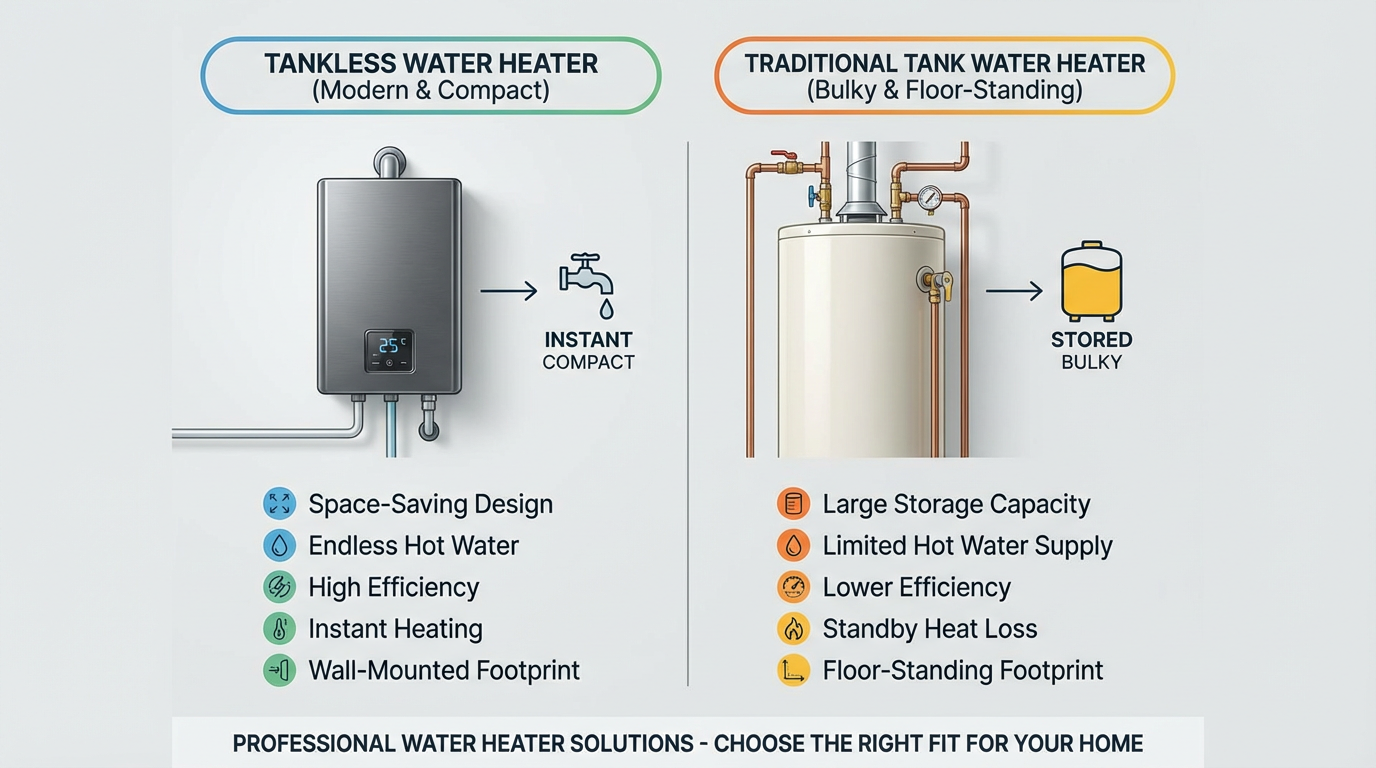
| Feature | Traditional Tank | Tankless |
|---|---|---|
| Upfront Cost | Lower | Higher |
| Energy Efficiency | Moderate (standby loss) | High (on-demand heating) |
| Lifespan | 8–12 years | 20+ years |
| Physical Size | Large (floor space required) | Compact (wall-mounted) |
| Hot Water Supply | Limited to tank capacity | Continuous (within flow rate) |
| Maintenance in Hard Water | Annual tank flush | Annual descaling flush |
| Flood Risk | Higher (tank rupture possible) | Minimal |
| Best For | Budget-conscious, straightforward replacement | Long-term savings, space-saving, high-demand homes |
Which Water Heater Is Right for Your San Antonio Home?
There's no single "best" water heater — the right choice depends on your household's specific circumstances. Here's a framework to help you decide:
A Traditional Tank May Be Your Best Fit If:
- You're working within a tighter budget and want lower upfront costs.
- Your home is already plumbed for a tank unit, and you want a straightforward swap.
- You have moderate hot water needs (1–3 people in the household).
- You plan to sell the home in the near future and want a cost-effective replacement.
A Tankless Unit May Be Your Best Fit If:
- You want to invest in long-term energy savings and a unit that will last 20+ years.
- Your household has a high hot water demand (large family, multiple bathrooms).
- You're renovating or building new and can easily accommodate tankless installation.
- You value reclaiming garage or closet space currently occupied by a bulky tank.
- You already have (or plan to install) a water softener to protect the heat exchanger.
Not sure which option is right for your home? The licensed plumbers at Bluebonnet Plumbing evaluate your household size, hot water usage patterns, existing plumbing infrastructure, and budget to recommend the best water heater replacement for your San Antonio home. Call us at +1 210-806-7285 Monday–Friday, 8 AM – 5 PM to schedule a consultation.
What to Expect During a Water Heater Replacement with Bluebonnet Plumbing
Whether you choose a traditional tank or a tankless unit, here's what a typical water heater replacement in San Antonio looks like when you work with Bluebonnet Plumbing:
- In-Home Assessment: We inspect your current water heater, evaluate your home's plumbing and gas/electric connections, and discuss your hot water needs.
- Personalized Recommendation: Based on your household size, water usage, and budget, we recommend the best unit and configuration — no high-pressure upselling.
- Professional Installation: Our licensed technicians handle the full installation, including removing and disposing of your old unit, connecting the new water heater, and ensuring everything meets local code requirements.
- Testing & Walkthrough: Before we leave, we test the system thoroughly and walk you through basic operation and maintenance tips — like how often to flush or descale your new unit in San Antonio's hard water.
Thinking about replacing your water heater? Contact Us today to schedule your in-home assessment and explore the best options for your home.
Maintenance Tips to Extend Your Water Heater's Life in San Antonio
Regardless of which type you choose, regular maintenance is the single most important thing you can do to protect your investment — especially with San Antonio's hard water. Here are our top recommendations:
For Tank Water Heaters
- Flush the tank annually to remove sediment buildup caused by hard water minerals.
- Test the temperature and pressure (T&P) relief valve once a year to ensure it's functioning safely.
- Inspect the anode rod every 2–3 years. This sacrificial rod protects the tank interior from corrosion — and it depletes faster in hard water.
- Check for leaks around fittings, the base of the tank, and the T&P valve discharge pipe.
For Tankless Water Heaters
- Descale the heat exchanger annually using a vinegar flush or a professional descaling service. In San Antonio, this is non-negotiable.
- Clean the inlet water filter every 6 months to prevent debris from restricting flow.
- Check the venting system (for gas units) to ensure there are no blockages or corrosion.
- Consider pairing with a water softener to dramatically reduce mineral buildup and extend maintenance intervals.
Need water heater maintenance or a replacement? Bluebonnet Plumbing serves homeowners across San Antonio — from Alamo Ranch to the Medical Center, Stone Oak to Southtown. Call +1 (210) 934-5468 Monday–Friday, 8 AM – 5 PM, or fill out our online contact form to get started.
Frequently Asked Questions About Water Heater Replacement in San Antonio
How do I know it's time to replace my water heater?
Common signs include inconsistent water temperature, rusty or discolored hot water, unusual noises (popping or rumbling), visible leaks around the base of the unit, and age — most tank water heaters in San Antonio's hard water last 8–12 years. If your unit is over 10 years old and showing any of these symptoms, it's wise to schedule an inspection.
Is a tankless water heater worth the higher upfront cost?
For many San Antonio homeowners, yes. When you factor in the longer lifespan (20+ years vs. 8–12), lower monthly energy bills, and reduced flood risk, a tankless unit often delivers a strong return on investment — especially if you plan to stay in your home long-term. However, if budget is your top priority for a straightforward replacement, a traditional tank remains a solid, reliable choice.
Will San Antonio's hard water damage my tankless water heater?
It can, if maintenance is neglected. Hard water causes mineral scale to accumulate inside the heat exchanger, reducing efficiency and potentially causing the unit to shut down. Annual descaling is essential. Pairing your tankless water heater with a whole-home water softener is one of the best ways to protect the unit and extend its life in San Antonio.
Can I switch from a tank water heater to a tankless unit?
Absolutely. It's one of the most common upgrades we perform at Bluebonnet Plumbing. The installation may require modifications to your gas line, venting, or electrical connections, depending on your home's current setup. During your in-home assessment, we'll outline exactly what's needed so there are no surprises.
What size tankless water heater do I need for my San Antonio home?
Sizing depends on two factors: the flow rate (how many gallons per minute your household uses simultaneously) and the temperature rise (the difference between incoming water temperature and your desired output). In San Antonio, warmer incoming groundwater means you may need a smaller temperature rise than homeowners in northern states, which can work in your favor. A Bluebonnet Plumbing technician will calculate the right size during your consultation.
How long does a water heater replacement take?
A straightforward tank-to-tank replacement typically takes 2 to 3 hours. Switching from a tank to a tankless unit may take longer — usually half a day — depending on the complexity of the installation and any necessary plumbing or gas line modifications.
Do you install both gas and electric water heaters?
Yes. Bluebonnet Plumbing installs and services both gas and electric water heaters — including traditional tank models and tankless units. We'll help you evaluate which fuel type makes the most sense for your home based on your existing connections and energy preferences.
Does Bluebonnet Plumbing also install water softeners?
We do. Given San Antonio's extremely hard water, we frequently recommend and install whole-home water softeners alongside water heater replacements. A water softener protects not just your water heater, but also your pipes, fixtures, dishwasher, and washing machine from mineral scale buildup. It's one of the smartest investments a San Antonio homeowner can make.
San Antonio Trusts Bluebonnet Plumbing for Water Heater Replacement
At Bluebonnet Plumbing, we specialize in helping San Antonio homeowners navigate decisions just like this one. Whether you're replacing a failing tank water heater, upgrading to a tankless system, or simply need expert advice on what's best for your home and budget, our licensed, experienced plumbers are here to help.
We understand the unique challenges that come with plumbing in San Antonio — from our region's extremely hard water to the specific needs of homes in neighborhoods across the city. We don't believe in one-size-fits-all solutions. Every recommendation we make is tailored to your home.
Ready to talk about your water heater replacement? Contact Bluebonnet Plumbing today. We're located at 1917 El Monte Blvd, San Antonio, TX 78201, and we're available Monday–Friday, 8 AM – 5 PM. Call us at +1 (210) 934-5468 or use the contact form on our website to request a consultation. Let's find the right water heater for your San Antonio home.